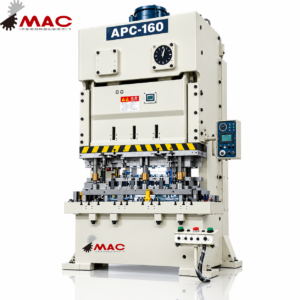
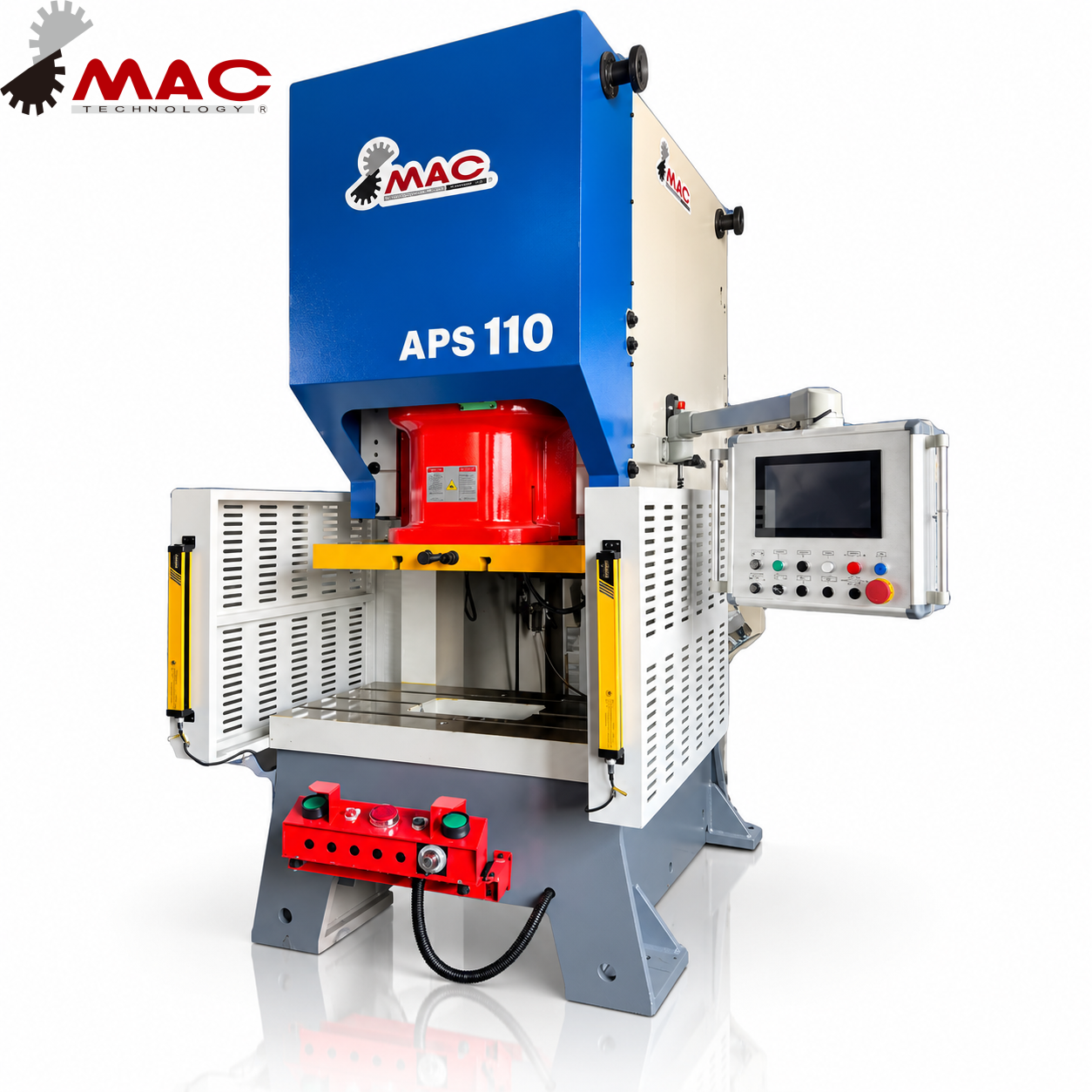
APS-110 H-Frame CNC Servo Press Machine
- 110-ton pressing capacity for a range of metal stamping and forming applications.
- Programmable servo slide motion to match the pressing profile to the workpiece and die.
- 40–90 strokes/min variable speed range for flexible production settings.
- Rigid welded H-frame, treated for stress relief to support stable pressing.
- Symmetrical dual balancers that help maintain smooth slide movement.
- Up to 0.1 mm die adjustment precision, as stated in the supplied product materials.
- 10-inch touchscreen control for machine settings and production monitoring.
- Automation-ready configuration with optional feeding, uncoiling, leveling, and part-handling equipment.
1S0 9001
Certiffed
SVG
Certiffed
CE
Certiffed
Global
Support
Product Features & Details
CNC Servo Control
The APS-110 uses a Siemens S7-200 PLC with a 10-inch touchscreen. The supplied configuration also lists a BySTORM controller, Tamagawa encoder, and Delta servo motor. Operators can set and monitor the press through the control interface, with preset and total counters included in the standard accessory list.
Unlike a press limited to one fixed slide profile, servo control allows the slide motion to be set according to the operation. The supplied materials illustrate motion profiles for processes such as stamping, coining, deep drawing, and fine blanking. The suitability of a specific process depends on the part, die, material, and selected machine configuration.
Rigid H-Frame and Stable Motion
The frame is welded from steel plates and treated for stress relief. This construction is intended to improve structural stability and maintain alignment during pressing. The transmission center is designed to align with the machine center, while symmetrical dual balancers help the slide run smoothly.
The crankshaft, gears, and connecting rods undergo hardening and grinding processes to improve the durability of the transmission components.
Adjustable Slide and Die Setup
The APS-110 provides a 90 mm stroke, 410 mm maximum die height, and 90 mm slide adjustment. Its electric slide adjustment makes die setup more convenient. The product materials state die adjustment precision of up to 0.1 mm, helping operators make controlled setup changes.
The 650 × 470 mm slide area and 1,150 × 600 mm bolster area provide the working surfaces for die installation. Die fit should be checked against the full tooling drawing, mounting positions, shut height, and required stroke.
Speed and Production Flexibility
The specified variable stroke rate is 40–90 strokes per minute, with a listed stable speed of 50 strokes per minute. The appropriate setting depends on the forming load, feed length, die design, and part quality requirements.
Optional equipment such as a feeder, uncoiler, leveler, and mechanical hand can be configured to support an automated production line.
Operation and Safety Equipment
The standard accessory list includes a touchscreen with preset and total counters, an emergency stop, an air ejector, an air source receptacle, and a maintenance tool box. A photoelectric safety device is listed as an optional accessory. The final guarding and safety arrangement should be specified for the installation and production process.
Technical Parameters
| Item | APS-110 |
|---|---|
| Press capacity | 110 ton |
| Rated tonnage point | 3 mm |
| Variable stroke rate | 40–90 strokes/min |
| Stable stroke rate | 50 strokes/min |
| Stroke | 90 mm |
| Maximum die height | 410 mm |
| Slide adjustment | 90 mm |
| Slide area | 650 × 470 mm |
| Bolster area | 1,150 × 600 × 110 mm |
| Shank hole diameter | Ø50 mm |
| Servo motor power | 75 kW |
| Slide adjustment drive | Electric |
| Required air pressure | 6 kg/cm² |
| Overall dimensions | 1,900 × 1,350 × 3,250 mm |
| Machine weight | 9.6 ton |
| Die cushion capacity* | 6.3 ton |
| Die cushion stroke* | 80 mm |
| Effective die cushion area* | 500 × 350 mm² |
*The parameter sheet lists die cushion specifications, but the accessory sheet lists the pneumatic die cushion device as optional. Confirm whether it is included in the quoted APS-110 configuration.
Customization Options
The following items appear in the supplied optional accessory list. Selection depends on the die, material, line layout, and production target:
- Material handling: Feeder, uncoiler, and leveler for coil-fed production.
- Part handling: Mechanical hand for transfer or removal tasks.
- Die changes: Quick die-change device with die lifter, clamps, and die arms.
- Forming requirements: Pneumatic die cushion device and slide knock-out device.
- Machine operation: Electric automatic lubrication system and foot switch.
- Installation and workspace: Anti-vibration press mounts and die room light.
- Additional safeguarding: Photoelectric safety device.
To configure the press, provide the part drawing, material grade and thickness, die drawing, feed length, required output, and preferred level of automation.
FAQ
What is the capacity of the APS-110?
The APS-110 has a specified 110-ton press capacity. Whether it is suitable for a part also depends on the required forming force, die dimensions, and where in the stroke the force is needed.
Can the pressing speed be adjusted?
Yes. The specification lists a variable range of 40–90 strokes per minute and a stable speed of 50 strokes per minute.
Is the APS-110 suitable for deep drawing?
The supplied materials show a servo motion profile for deep drawing, and a die cushion is listed in the parameters. Suitability for a particular drawn part must be checked against its required force, draw depth, die design, and whether the optional die cushion is included.
What are the available working areas?
The slide area is 650 × 470 mm, and the bolster area is 1,150 × 600 mm. Confirm tooling fit using the complete die and mounting drawings.
Is the die cushion standard?
The attachments are inconsistent on this point: the technical table gives die cushion parameters, while the accessory list labels the pneumatic die cushion as optional. Confirm its inclusion and specification before ordering.
Support & Service
Share your workpiece and die drawings with the sales and engineering team for machine selection and configuration review. The review should cover required tonnage, stroke, die height, working area, production speed, air supply, and optional automation. Request the final configuration sheet, installation requirements, operating manual, and service terms with the quotation.